
The Attention Economy: What is Digital Marketing
Did you know that in 2026, the average person spends 2 hours and 40 minutes daily on social media, yet their focused attention span has dropped to just 8 seconds? We are living in a “hyper-scroll” era where brand survival is no longer about who has the biggest budget, but who has the best map.
Recently I was having dinner with my family, I noticed my younger sister watching Instagram reels, the moment she saw something interesting she was completely hooked. I realized that the people don’t struggle to focus, they focus on what captures them instantly.
What is digital marketing in simple words? It is meeting your customers in the digital space where in they are already present. While traditional marketing throws a wide net and hopes for a catch, digital marketing is like an intelligent tracker it guides your message through the noise of the internet to land directly in front of the person who is already looking for it.
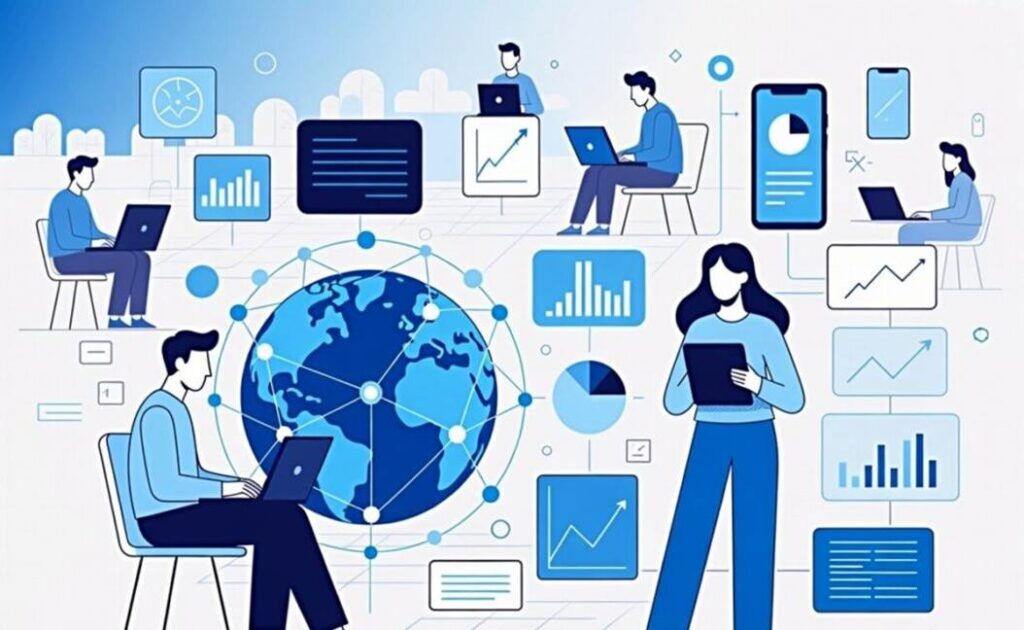
Benefits of Digital Marketing:
The shift to digital marketing isn’t just about being modern it’s about getting real, measurable results that actually help your business grow faster and smarter.
The Value of Data
Every interaction, whether a click, scroll, view, or “like,” generates important insights. Digital marketing can gather such data, eliminating the need for guesswork about what customers desire. This allows you to accurately determine which products capture their interest, which content engages them, and what ultimately compels them to click “buy.” This leads to well-informed decision-making.
Targeted Precision
Say goodbye to wasting resources advertising to individuals who are unlikely to be interested. Digital tools enable you to target your ads specifically to the appropriate audience-individuals of a certain age, residing in particular areas, with specific interests, or even those who have recently searched for something relevant to your product. You can also connect with them right when they are contemplating a purchase a moment referred to as “micro-moments”.
Flexibility
I remember seeing a billboard near my area which had spelling mistake in the brand name and there was nothing they could do about it. If a post or ad isn’t performing well, you can tweak the message, change the image, pause it completely or increase your budget on the parts that are working based on real-time results
The ROI
As you see in the example I sited above, why do you think they couldn’t make the changes in the billboard? Its because it would have involved reprinting, redesigning and would have been much more expensive. Now, that’s where digital marketing wins. You can edit it within no time and that to at zero or minimal cost.
Challenges of Digital Marketing:
The digital world is a double-edged sword. To win, you must navigate these modern hurdles
The “Social Search” Shift:
For the first time, platforms like Instagram are surpassing Google for product discovery among younger audiences. Imagine you want to buy a new face wash. A few years ago, you’d Google “best face wash for oily skin” Now? You open Instagram and search the same thing and suddenly there are hundreds of videos of real people showing results, before and after, honest reviews. That’s the shift. A small local brand selling amazing face wash but only focused on their website would never show up there even if their product is great.
AI Saturation:
With AI-generated content increasing by over 200% this year, the challenge is maintaining a human, authentic voice that doesn’t sound like a bot. You know when you read something and it just feels flat? Like a school textbook? That’s usually AI-written content with no personality. Imagine two Instagram pages selling the same handmade jewelry. One posts: “Our products are crafted with care and precision.” The other posts: “I made this ring at 2am during a power cut and honestly it’s my favorite piece yet.” You’re going to follow the second one – every time.
Ad-Blocker Rise:
Think about how fast you hit “Skip Ad” on YouTube. Millions of people have gone one step further and installed apps that remove ads entirely. So, if a small bakery near you is only running paid ads to get customers, a huge chunk of people will never even see them. But if that same bakery posts a satisfying reel of frosting a cake? People share it for free.
Data Privacy :
The “ads following you around” problem: You know that feeling when you searched for sneakers once and now every website is showing you sneaker ads for a week? That’s third-party tracking. But Apple and Google are shutting that down to protect user privacy. So, brands that relied entirely on that kind of targeted advertising are now struggling to reach the right people. The smarter brands are instead asking customers to willingly sign up for WhatsApp updates or email newsletters so they don’t need to chase people around the internet.
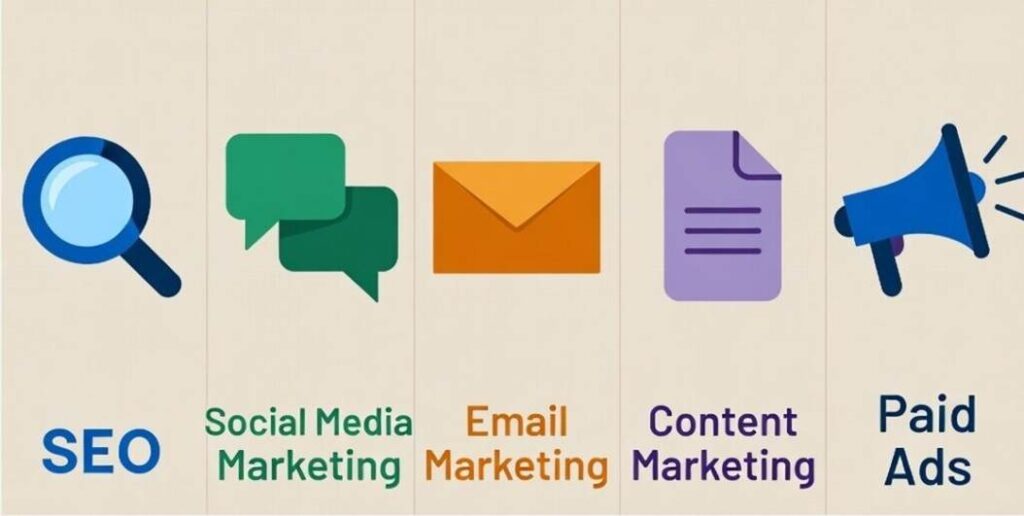
Types of Digital Marketing
Think of digital marketing as a diverse ecosystem. You don’t need every animal, but you need the right ones for your climate:
SEO & AI Search – Get Found, Effortlessly :
When you type something into Google or ask ChatGPT a question, have you ever wondered why certain brands or websites show up first? That’s SEO (Search Engine Optimization) doing its job. And now, with AI-powered search on the rise, businesses also need to make sure AI chatbots recommend them not just search engines. If your content answers real questions clearly, you rise to the top. Simple as that.
Influencer Marketing Word of Mouth, But Amplified:
Partnering with trusted voices. When a creator you follow on Instagram or YouTube says “I genuinely love this product,” it feels personal. In 2026, 94% of organizations report that influencers outperform traditional ads. People trust people, not banners.
Content Marketing –Teach First, Sell Later:
Creating valuable blog posts, podcasts, or videos that solve problems for your audience. The idea is simple: if a brand consistently helps you for free, you’ll naturally think of them when it’s time to buy. It builds trust slowly, but deeply.
First-Party Data Marketing – Own Your Audience:
Social media algorithms are unpredictable your post might reach 10,000 people today and 200 tomorrow. That’s why smart brands are building direct connections through newsletters and SMS marketing. When someone gives you their email or phone number, you have a direct line to them – no algorithm, no middleman. Think of it as building your own loyal fan club, one subscriber at a time.
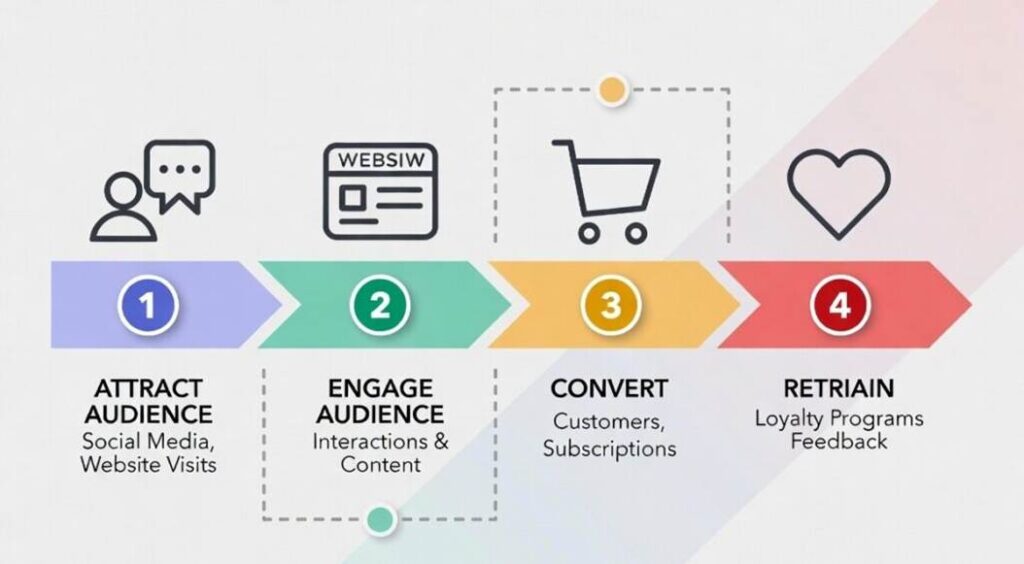
How to do Digital Marketing:
Successful digital marketing is a cycle, not a straight line.
Step 1: Define Your “Why” – Know What You’re After before you create a single post or run a single ad, ask yourself one honest question: What do I actually want? Are you trying to build trust slowly becoming the brand people think of first when they need something? Or are you going after quick sales right now? These are two very different goals, and they need two very different strategies. A new skincare brand trying to build credibility will take a very different approach than a shop running a 48-hour sale. Know your why first everything else follows from there.
Step 2: Create “Stop-the-Scroll” Content – You Have 8 Seconds . Here’s a hard truth nobody online is waiting to hear from you. People are scrolling fast, skipping ads, and moving on in milliseconds. You have roughly 8 seconds sometimes less to make someone pause and pay attention.
Instead of: “Hi, we’re XYZ brand and we’ve been in business since 2010”
Try: “Here’s why your moisturizer isn’t actually working and what to do instead.”
The second version makes you stop. The first one doesn’t. That’s the difference between content that gets ignored and content that gets shared.
Step 3: Use the Feedback Loop – Let the Data Talk
Once your content is out there, your job isn’t done it’s just beginning. This is where analytics come in, and they’re simpler than they sound. Think of it like this: imagine you own a physical store. If you notice that customers walk in, browse, reach the billing counter and then leave without buying you’d want to know why, right? Is the price confusing? Is the queue too long? Is something broken?
Digital marketing works the same way. Tools like Google Analytics show you exactly where people drop off If visitors are leaving your website the moment they land your opening hook isn’t working. Fix the first impression.
If they browse happily but abandon at checkout , there’s friction at the finish line. Maybe the payment process is complicated, or shipping costs are a surprise. Fix that last step. Every “exit” is a clue. The best digital marketers aren’t just creative they’re curious. They follow the data and keep tweaking until it works
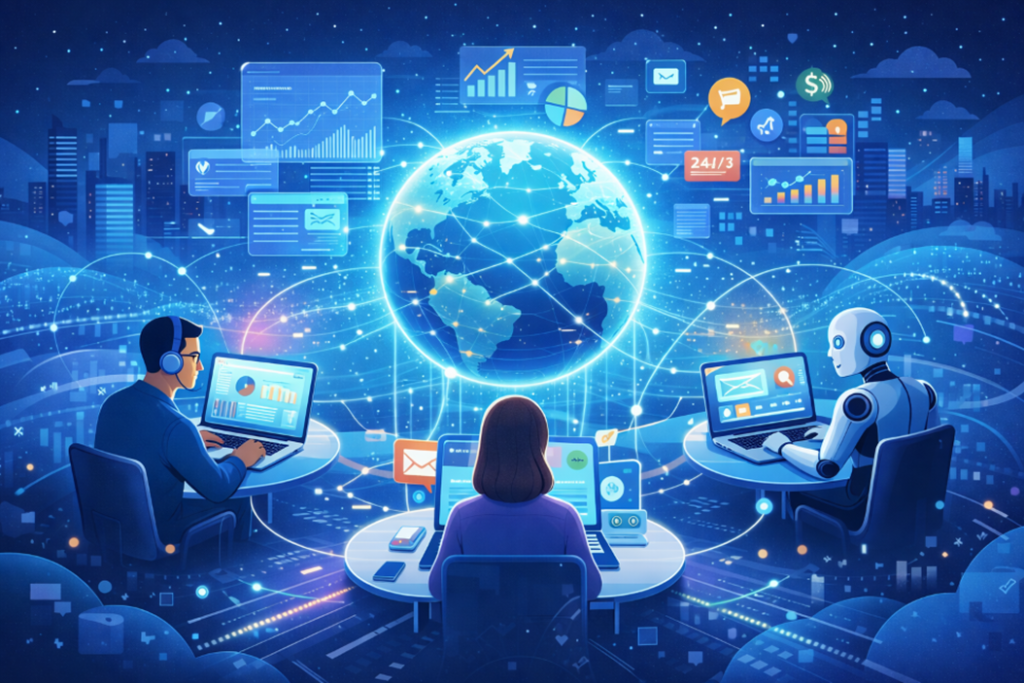
5.Scope of Digital Marketing:
Think about the last time you bought something online, watched an ad on YouTube, or saw a brand pop up on your Instagram feed. That’s digital marketing working in real time and its reach is only growing.
Digital marketing today isn’t confined to just emails or social media posts. It has woven itself into almost every part of our daily lives. Whether you’re scrolling through reels at midnight, asking Google for the “best pizza near me,” or getting a personalized discount code on your birthday all of that is powered by digital marketing.
We’re entering the “Phygital” era
Imagine pointing your phone at your living room wall and seeing exactly how a new sofa would look there before spending a single rupee. Or trying on sunglasses virtually without stepping into a store. This blend of the physical and digital world is called Phygital marketing and it’s already here.
Brands like IKEA and Lens kart use Augmented Reality (AR) to let you “experience” products from the comfort of your home.
The numbers speak for themselves by the end of 2026; the world is expected to spend close to $800 billion on digital advertising that’s more than the GDP of many countries. Every click, every search, every “swipe up” is part of a massive, invisible economy.
It’s not just a department anymore. In the past, a company might have had a small “marketing team” tucked away in a corner. Today, digital marketing is the business. It’s how brands find customers, how startups grow overnight, how a home baker in Bengaluru can sell cookies to someone in Mumbai – all through a phone screen.
In short, if a business wants to survive and thrive today, digital marketing isn’t optional. It’s the heartbeat of modern commerce
How to Start Digital Marketing:
If you have been watching other brands grow online and thinking “I don’t even know where to begin” this is for you. The biggest mistake beginners make? Trying to be everywhere at once. One day they’re posting on Instagram, the next they’re starting a podcast, then a YouTube channel and within two weeks, they’re burnt out with nothing to show for it.
The fix is beautifully simple. It’s called the 1-1-1 Rule
- 1 Platform: Pick the one where your audience is most active (e.g., LinkedIn for professionals, TikTok for Genz).
- 1 Format: Are you better at writing, speaking, or being on camera? Stick to your strength.
- 1 Conversion Goal: What is the one thing you want them to do? Sign up for a newsletter or Buy a product?
Conclusion
Digital marketing is no longer a luxury or a side-project; it is the fundamental infrastructure of modern business. As we have seen, the scope of digital marketing is moving toward a highly automated, AI-driven future, but the core objective remains unchanging: to provide the right solution at the exact moment of need.
While the challenges of digital marketing from shrinking attention spans to shifting algorithms are real, they are not unconquerable for those who prioritize strategy over shortcuts. By mastering how to do digital marketing with a focus on data-backed storytelling and user intent, you move beyond the noise. You stop being a “content creator” and start becoming a market leader.
The barrier to entry has never been lower, but the bar for quality has never been higher. With the primary keywords now in your arsenal and the roadmap in front of you, the next step is simply to begin. The digital landscape is ready for your contribution; it’s time to make your mark.
Want to know what is Digital Marketing- Explore the full guide here
FAQ:
1.Is digital marketing only for big brands and corporations?
Far from it. In fact, digital marketing levels the playing field a small home baker in Bengaluru can reach thousands of potential customers with just a smartphone and a good Instagram strategy. Size doesn’t matter nearly as much as consistency and authenticity do.
2. Do I need to know coding or tech to do digital marketing?
Not at all. Most modern tools – like Canva for design, Mailchimp for emails, or Wix for websites – are built for everyday people with zero technical background. If you can use WhatsApp, you already have the basic skills to get started.
3. Can I do digital marketing alone or do I need a team?
Plenty of solo creators and small business owners run highly effective digital marketing entirely on their own – especially in the early stages. As you grow, you can outsource specific tasks like design or ads. Start lean, learn the basics yourself first, then delegate smartly
4. How long does it take to see results from digital marketing?
It depends on the method. Paid ads can show results within days, but organic strategies like SEO or content marketing typically take 3 to 6 months to gain momentum. Think of it like planting a tree – the best time to start was yesterday, the second-best time is today.
5. Is “AI” replacing Digital Marketing?
No, AI is just a sharper tool. It helps marketers write faster, analyse data better, and predict what people want to see. But marketing still requires a “human” touch to understand emotions, tell stories, and build real trust-things an AI can’t do on its own.