
What is SEO in Digital Marketing? A Train Lesson.
I wasn’t planning to learn anything that evening. Then she opened her phone and showed me something that changed how I think about the internet.
- What is SEO in Digital Marketing.
- 10 mins read
- Personal experience
It was one of those long train journeys where you stare out the window for the first hour, then slowly start looking for any excuse to talk to someone. The woman sitting across from me had a small cloth bag on her lap the kind that tells you immediately that the person made it themselves. Delicate embroidery. Tiny silver clasps. The sort of thing you would spend twenty minutes admiring at a craft fair.
I asked about it. She smiled like she had been waiting for someone to notice.
Her name wasn’t important she never gave it, and I never asked. What mattered was what she told me over the next two hours, somewhere between the rattling of the train and the chai that appeared at the next station.
She made handmade jewellery. Had been doing it for three years. Earrings, necklaces, anklets all hand-crafted, most of them one of a kind. She had an Instagram page, a website, and genuinely beautiful work. And for the first two years, almost nobody outside her own city knew she existed.
“I had the work. I just didn’t have the visibility.”
That’s the line that stayed with me. She said it quietly, not bitterly, the way you say something once you’ve already made peace with it.
A friend had eventually introduced her to something called SEO – Search Engine Optimization. And the way she explained it to me, I think, is the clearest explanation I’ve ever heard.
“Imagine the internet is a huge, endless marketplace,” she said. “Thousands of stalls. Millions of products. Google is the person standing at the entrance, pointing customers in a direction when they ask for something. SEO is how you make sure Google points them to you.”
“You don’t pay Google to point at you. You earn it by being clear about what you offer, trustworthy enough for others to vouch for you, and easy enough for Google to find and understand.”
She told me that before SEO, her website was essentially invisible. Someone typing “handmade silver earrings online India” would never find her even though that was exactly what she made. Her website existed, but Google didn’t really understand what it was about.
Three Pillars Of SEO
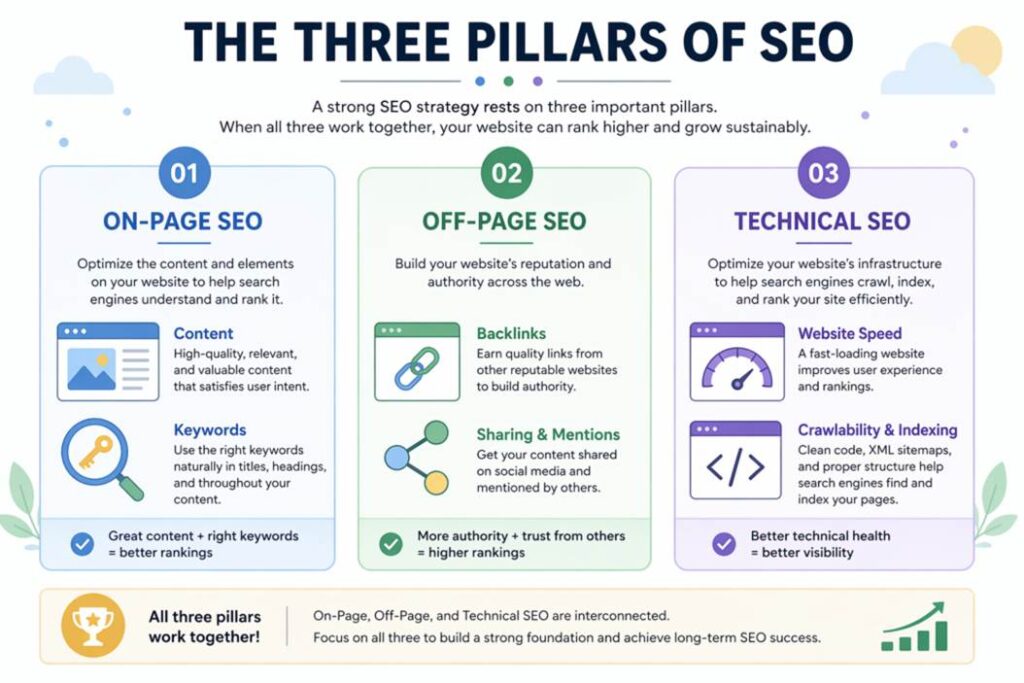
The three things she had to fix:
I asked her how she started. She pulled out her phone and showed me a note she had saved- three things her friend had told her to work on. She called them the three pillars, and even now I remember them exactly the way she described them.
On-page SEO
The words on your own website. Does your page actually say what you sell? Google reads your content if it’s vague, Google stays confused.
Off-page SEO
Your reputation across the internet. Other websites mentioning or linking to yours act like trusted recommendations. Google takes them seriously.
Technical SEO
The invisible infrastructure, how fast your site loads, whether it works on a phone(mobile friendly), how easy it is for Google’s bots to crawl through it.
Her website had failed on all three counts. The product pages said things like “Collection 4” and “New Arrivals” beautiful to look at, meaningless to a search engine. Nobody outside her own circle had ever linked to her site. And the site itself took nearly seven seconds to load on mobile, which she hadn’t even noticed until her friend pointed it out.
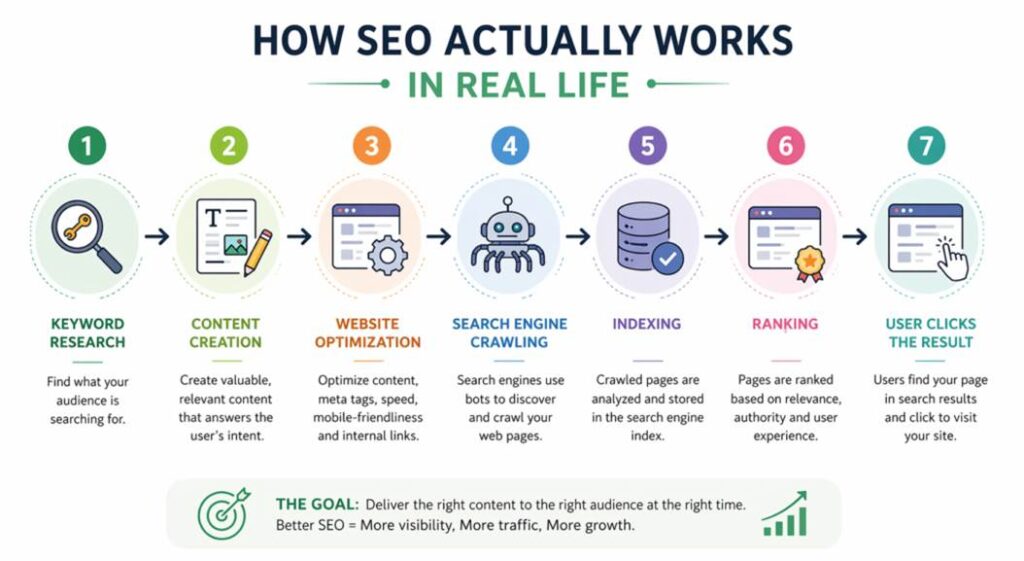
How does SEO actually work
What she actually did and what happened
She rewrote every product page with real descriptions. Not just “silver ring” but “handcrafted oxidised silver ring with tribal motif, made in Jaipur.” Specific. Searchable. Human. The kind of thing someone actually types when they are looking for exactly that thing.
On-page in practice: She renamed her collection pages from vague labels to phrases her customers actually searched for -“handmade silver jewellery online,” “boho earrings India,” “tribal anklets handcrafted.” Within weeks, Google began showing her pages for searches she would never even target.
Then something unexpected happened. A popular handicraft blogger came across her Instagram, visited her website, and wrote a small piece about independent jewelry makers doing interesting work. She linked to the site. One link. But to Google, it was a vote of confidence from a credible voice and her rankings shifted almost immediately.
Off-page in practice: She didn’t chase that mention. It came because her work was genuinely good and her website was now easy to navigate and understand. One quality backlink from a trusted source, she told me, did more than she would have expected. “It felt like someone finally introduced me at the right party,” she said.
The technical fixes took a weekend. Her friend compressed the images, cleaned up some code, and the site went from seven seconds to under two. Bounce rates dropped, people were actually staying, scrolling, reading.
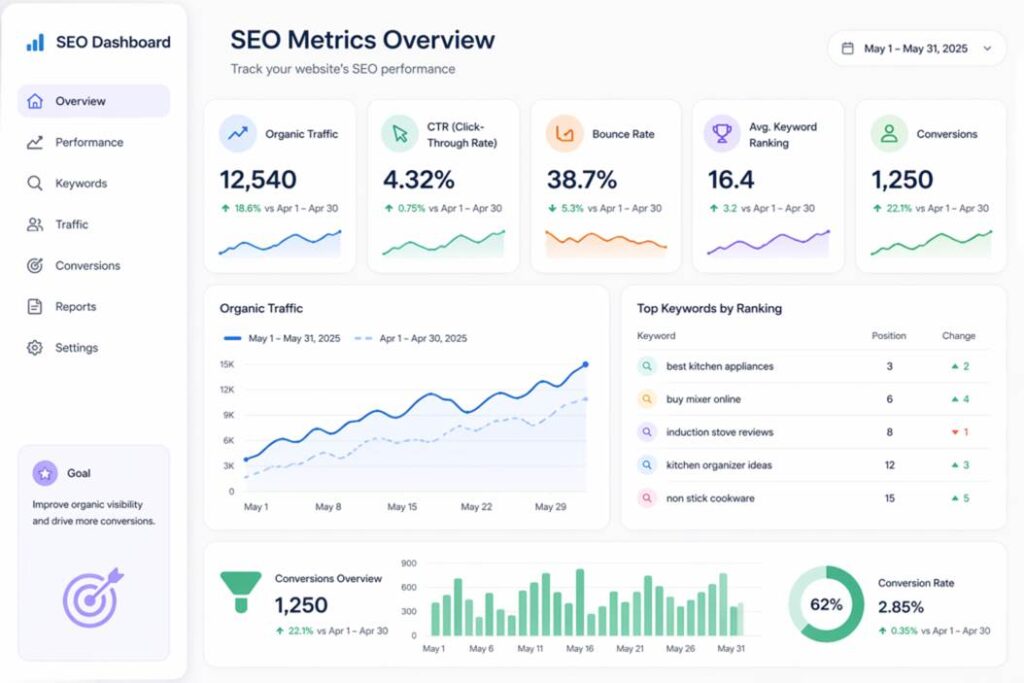
What metrics should you measure for SEO success.
How did she know any of it was working?
I asked her this directly. She laughed a little said she had asked the same thing in exactly the same way. Her friend had shown her six numbers to watch. She listed them for me on her fingers:
Organic traffic– Visitors arriving from search, not ads, not social.
Keyword rankings– Where her pages showed up for specific searches
Click-through rate– How many people saw her result and actually clicked
Bounce rate– Whether visitors stayed or left immediately
Backlinks– How many quality sites had mentioned or linked to hers
Page speed (Load time) – especially on mobile, where most buyers browse
Three months after she started, her organic traffic had tripled. She was ranking on page one for two of her target searches. Orders were coming in from cities she had never sold to before – Pune, Hyderabad, even a few from outside India.
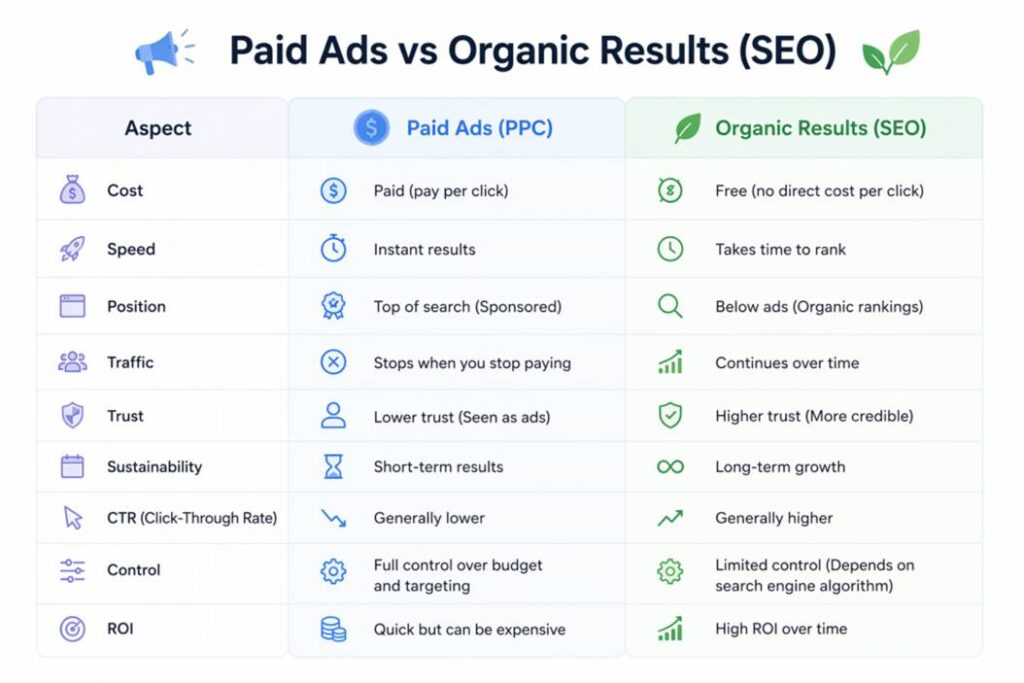
Difference between paid ads and organic results:
At some point I asked the obvious thing: why not just run ads? It’s faster, right? She nodded – she had tried that too, early on. Spent money. Got clicks. Stopped spending. The clicks stopped immediately.
Paid ads
Fast visibility, but rented. The moment you stop paying, you disappear. Good for short bursts not a foundation.
Organic SEO
Slow to build, but owned. Every improvement compounds. A page optimised today keeps bringing visitors for years for free.
“Ads are like switching on a light,” she said. “SEO is like building a window. One needs electricity to work. The other just lets the light in.”
I’ve thought about that line a lot since.
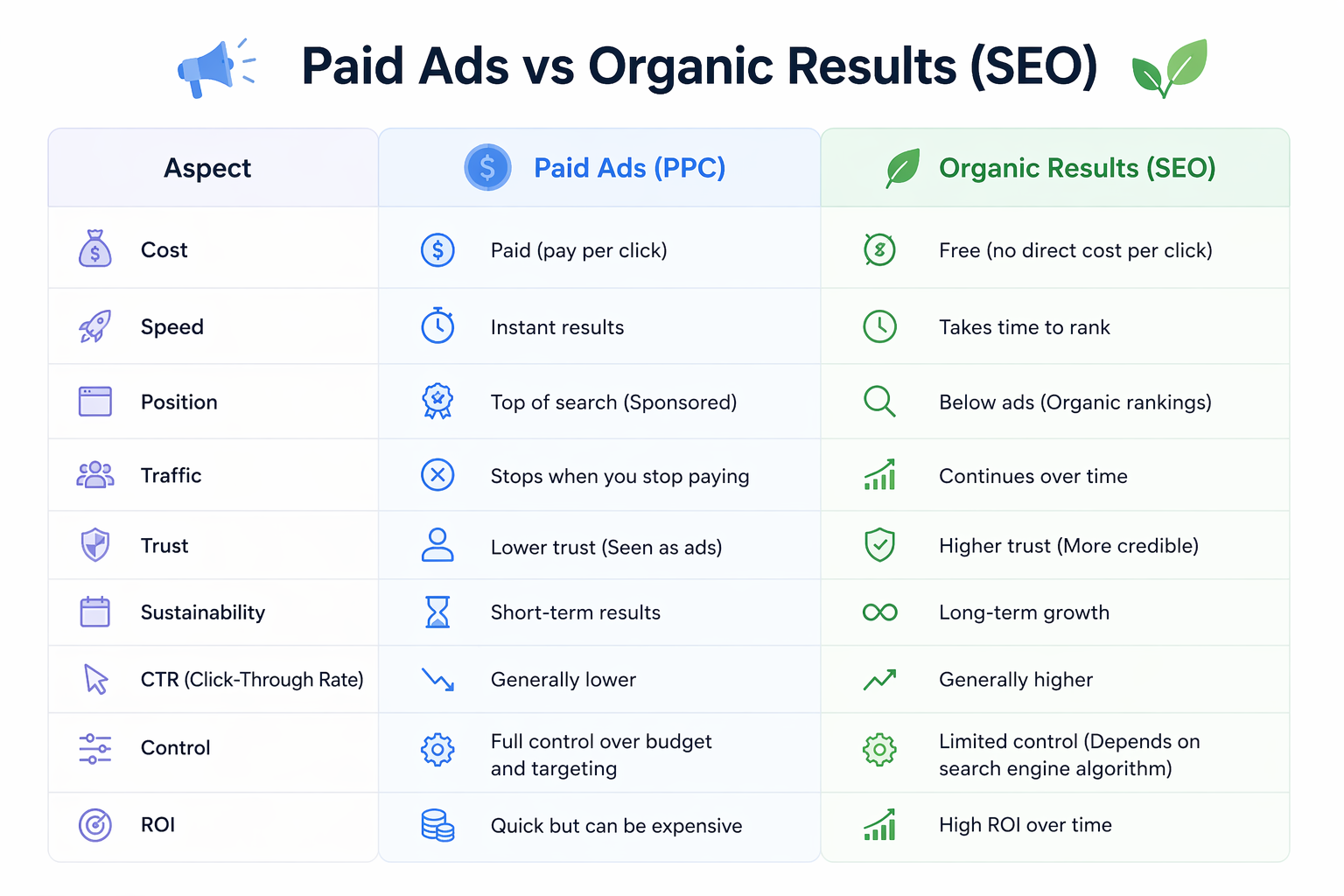
Role of SEO in digital marketing
What I took away from that train journey: By the time we pulled into the station, I felt like I have attended a masterclass I hadn’t signed up for. She packed her cloth bag, tucked her phone away, and smiled the way people smile when they’ve figured something out the hard way and are quietly glad, they did.
She wasn’t a marketer. She wasn’t a tech person. She was someone who made beautiful things with her hands and had simply learned slowly, patiently how to make sure the right people could find them.
That’s what SEO actually is, when you strip away all the jargon. It’s not a trick. It’s not gaming the system. It’s the work of making yourself genuinely findable- by being clear about what you offer, earning trust over time, and showing up consistently for the people who are already looking for exactly what you do.
The internet is enormous. Most of us are invisible in it by default. SEO is simply the decision to stop being invisible.
What the conversation taught me
You don’t need a big budget, a marketing team, or years of experience to start. You need clarity about what you offer, who’s searching for it, and how to speak their language. A stranger on a train figured that out with a cloth bag, a phone, and a patient friend. So can you.
What I took away from that train journey
I didn’t expect a conversation about handmade jewellery to teach me something lasting about the internet. But the best lessons rarely arrive when you plan for them.
She wasn’t invisible because her work wasn’t good. She was invisible because the right people couldn’t find her yet. SEO fixed that not overnight, but steadily, quietly, for good.
The internet doesn’t reward the best. It rewards the best that can be found. SEO is simply the work of making sure that’s you.
You might be invisible too and not even know it.
If you have something worth offering, the first step isn’t a big decision. It’s a small one go look at your website the way Google sees it. You might be surprised what you find.
I help people and businesses get found online. If that sounds like something you need, start here.
Still have questions? This might answer them. Check it out here.
FAQ
Is SEO an IT skill?
SEO (Search Engine Optimization) is not purely an IT skill, but it does include some technical elements. It is mainly a digital marketing skill that focuses on improving a website’s visibility on search engines like Google. While basic SEO can be done without technical knowledge, advanced SEO may require some understanding of website structure, coding, and analytics.
Is SEO a one-time process or ongoing?
SEO is an ongoing process, not a one-time task. Search engines like Google regularly update their algorithms, and your competitors are also constantly improving their websites. To maintain and improve your rankings, you need to update your content, add new keywords, build backlinks, and fix technical issues regularly. Continuous SEO efforts help your website stay relevant, visible, and competitive in search result
How long does SEO take to show results?
SEO usually takes 3 to 6 months to show noticeable results.
What are the basic steps of SEO?
Choose the right keywords, create quality content, and optimize your website.
Then build backlinks and track performance.