
A year ago, using AI in a marketing team meant someone had a ChatGPT tab open for first drafts. Today it’s running the bid strategy on your ad account, drafting the personalization logic behind your emails, and increasingly deciding what your customers see before a human ever reviews it. That’s the real shift in AI in digital marketing in 2026: it’s stopped being a tool marketers occasionally reach for and started becoming infrastructure sitting underneath search, advertising, personalization, analytics, and customer service all at once. Understanding where it’s actually changing outcomes and where it’s just automation with better branding is the difference between using AI well and just using it a lot
The Evolution of AI in Digital Marketing
Marketing automation used to mean rules a person wrote in advance. AI-powered systems behave differently they read what’s actually happening and adjust.
From Automation to Intelligence
Old-school automation: if a shopper abandons their cart, send email B three days later. It works, but it’s rigid the logic never updates itself. Modern AI systems instead analyze live data, spot patterns a person would likely miss, and adjust recommendations as behavior changes, rather than following a script written months ago.
From Creating Content to Influencing Decisions
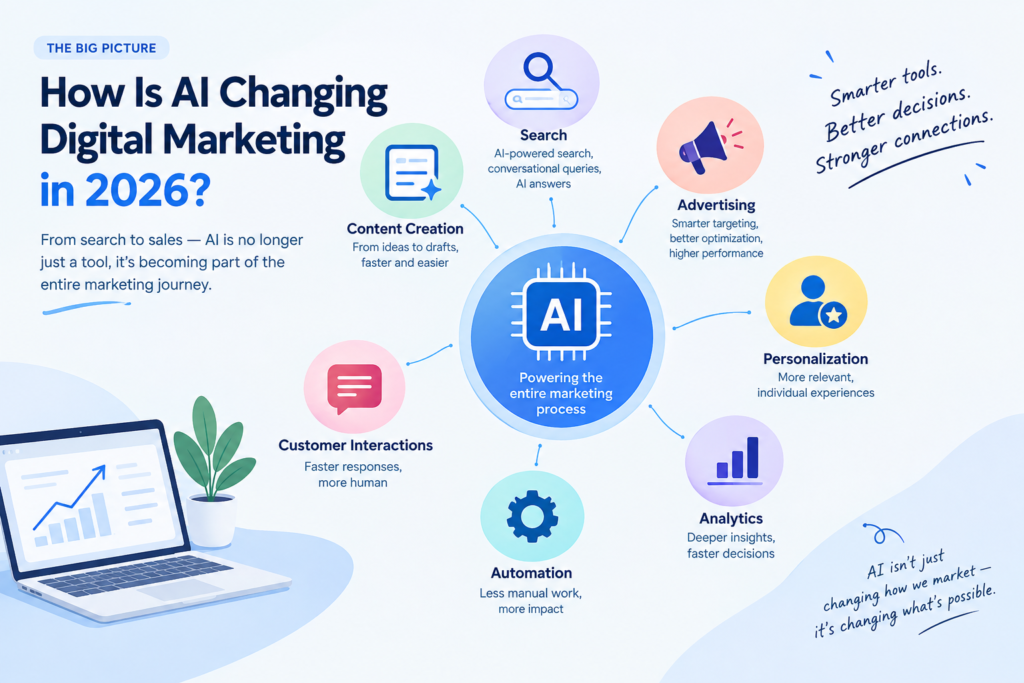
The first wave of marketing AI was mostly about output blog drafts, captions, ad copy. That’s still useful, but it’s no longer the interesting part. Marketers now lean on AI for data analysis, personalization at scale, campaign optimization, predictive insights, and customer segmentation. Put simply: AI is moving from helping marketers execute tasks to helping them make marketing decisions. That’s a bigger shift in responsibility than it sounds like.
Key Areas Where AI Is Transforming Digital Marketing in 2026
AI Is Changing How People Search
Search behavior has genuinely changed. Once AI-generated answer summaries became a standard part of results pages, and conversational tools took off alongside them, a growing share of queries now get answered without a single click to a website. Google has said publicly that pages don’t need special tricks to appear in these AI-generated answers content quality, trust signals, and topical authority remain what decide selection.
What Does This Mean for Marketers?
Ranking for a keyword isn’t the whole game anymore. Content strategy needs to focus on:
- Answering the actual question behind a search, not just matching the phrase
- Building comprehensive, genuinely useful coverage instead of thin pages
- Demonstrating real expertise original data, credentials, first-hand experience
- Writing in natural, conversational language rather than keyword-stuffed copy
Getting cited inside an AI-generated answer is still visibility it just comes through a different door than a top-three ranking used to.
Personalization Is Becoming More Intelligent
AI can now read far more customer signal than before browsing patterns, purchase history, email engagement, even timing preferences and use it to personalize emails, product recommendations, and on-site offers at a scale that used to require a much larger team.
The Challenge
More personalization isn’t automatically better marketing. It depends on:
- Clean, accurate first-party data the output is only as good as what goes in
- Respecting customer privacy and being transparent about how data is used
- Targeting relevance rather than targeting volume
- Not letting personalization tip into feeling invasive
A recommendation engine that seems to “know too much” can damage trust faster than it grows revenue.
AI Is Reshaping Paid Advertising
Inside Google Ads, Meta Ads, and similar platforms, AI already handles much of what used to be manual: audience targeting, bid optimization, creative variation testing, and budget allocation across campaigns.
What Changes for Advertisers?
The advertiser’s role is shifting away from adjusting every setting by hand and toward: Strategy → Creative Direction → Data → Testing → Business Outcomes. AI can execute and optimize continuously, but someone still has to define what the campaign is meant to achieve and why that goal matters to the business.
Content Creation Is Becoming Faster
Generative AI has genuinely sped up producing blog outlines, headlines, ad copy, social posts, email drafts, and video scripts.
More Content Doesn’t Mean Better Content
The catch: when everyone can produce content quickly, speed stops being the advantage. What actually differentiates now is original insight, real storytelling, a consistent brand voice, subject-matter expertise, and careful fact-checking. When production gets easier for everyone, quality and differentiation matter more, not less.
AI Is Changing Customer Interaction
Chatbots, AI agents, and conversational tools now handle a growing share of lead qualification, routine support questions, and product recommendations — often instantly, at any hour. Done well, this means faster answers without the interaction feeling robotic. Done poorly, it means customers stuck in a loop of canned replies. Speed only helps if the experience still feels human-centered.
Emerging Trends in AI-Powered Marketing
AI Agents Will Take on More Marketing Tasks
Unlike a basic content generator, an AI agent can take a goal, check relevant data, make a decision, and act sometimes across several connected tools in sequence, not just answer a single prompt.
What Could AI Agents Do?
Realistically, in the near term that means agents that monitor campaign performance and flag anomalies, surface opportunities worth a marketer’s attention, qualify inbound leads, handle routine customer queries, and recommend next steps. It doesn’t mean a fully autonomous marketing department human oversight is still very much the norm.
AI Search Will Change Content Strategy
Marketers increasingly need to think about visibility across search engines, AI-generated answers, and conversational discovery tools together, rather than optimizing for one channel in isolation. Being genuinely useful and well-sourced is what earns a spot across all of them.
Hyper-Personalization Will Become More Common
As AI reads customer signals more precisely, individualized experiences will keep expanding and scrutiny over how that data is collected will expand right alongside it. Privacy expectations and regulation are both trending toward more transparency and more customer control, not less.
Human + AI Collaboration Will Become the Norm
The most effective marketers aren’t the ones avoiding AI, and they’re not the ones letting it run unchecked either. It comes down to combining AI skills + marketing fundamentals + creativity + analytical thinking. AI without marketing judgment produces technically fine campaigns that miss the point. Marketing judgment without AI just moves slower than the competition.
Why Learning AI in Digital Marketing Matters
AI Skills Can Improve Marketing Efficiency
Handing off repetitive work data pulls, first drafts, routine reporting frees up real time for strategy, experimentation, creative development, and deeper customer analysis.
Learning AI Doesn’t Mean Learning Only AI Tools
Knowing how to prompt a tool well isn’t the same as being an AI-capable marketer. That takes three things together:
Marketing Fundamentals
Customer behavior, positioning, content strategy, SEO, paid advertising, conversion optimization.
AI Capabilities
Generative AI, predictive analytics, automation, AI agents, AI-powered search, personalization.
Human Skills
Creativity, critical thinking, communication, strategy, decision-making.
The advantage shows up when someone moves fluidly between all three not when they’ve just memorized which tool to open for which task.
The Future of AI in Digital Marketing
Recent industry data backs up how fast this shift has moved: Salesforce’s State of Marketing survey found the share of marketers using generative AI in at least one recurring workflow climbed from 51% in 2024 to 87% in 2026, and McKinsey’s 2026 global survey found 82% of organizations now deploy AI in at least one business function, with marketing and sales the most commonly cited use case. Adoption, in other words, is no longer the open question how well it’s used is.
AI is now woven into search, SEO, advertising, personalization, content, automation, and customer engagement, and it’s making all of it more data-driven and efficient. But it doesn’t decide what your brand should stand for, read a room, or know which customer trade-off matters most that’s still on the marketer. Successful marketing still runs on strategy, creativity, customer understanding, data, and human judgment; AI strengthens each of those, it doesn’t stand in for any of them.
The real question for 2026 isn’t whether to adopt AI most teams already have. It’s whether you’re using it to think harder about your customers, or just to move faster without thinking at all.
Conclusion
AI is changing digital marketing by making search, advertising, content creation, personalization, analytics, and customer interactions more intelligent and efficient. But AI is not replacing the need for good marketing it is changing how marketers approach it.
In 2026, the marketers who understand how to combine AI with strong marketing fundamentals will be better equipped to adapt to changing customer behaviour and digital trends. The key is not simply using more AI tools, but knowing where AI can actually add value while keeping strategy, creativity, and human understanding at the centre.
Interested in Learning More About Digital Marketing?
Digital marketing is constantly evolving, and there is always something new to explore from SEO and paid advertising to social media, ecommerce, analytics, and AI-powered marketing.
Explore More Digital Marketing Insights
Frequently Asked Questions About AI in Digital Marketing
Is AI replacing digital marketers?
No. AI automates and assists with individual tasks drafting content, adjusting bids, scoring leads but strategy, creativity, brand judgment, and understanding customers still need a human marketer behind them.
How is AI used in digital marketing?
Common uses include content creation, personalization, predictive analytics, ad optimization, SEO research, chatbot-driven customer support, workflow automation, and campaign performance analysis.
What are the biggest AI marketing trends in 2026?
AI-powered and conversational search, AI agents taking on more operational tasks, deeper personalization, automated advertising, generative content at scale, and predictive analytics for decision-making.
Is AI important for digital marketing?
Yes , it’s now embedded in the platforms and workflows marketers use daily, per Salesforce data showing 87% of marketers now use generative AI in at least one recurring workflow. Pairing AI fluency with solid marketing fundamentals is increasingly what separates effective marketers from the rest.